
 PDF Download
 PubReader
 Export Citation
 Email the Author
 Share Facebook
 Share Twitter
 Cited by 1 Article
 Metrics (View:2,531)






1. Introduction
Words in human language are predominantly symbolic, which exhibits an arbitrary relationship between their forms and meanings. However, not all linguistic signs are totally arbitrary. A small portion of vocabulary shows a direct relationship between sound and meaning through onomatopoeia, where words imitate or indicate natural sounds. The current study focuses on onomatopoeic expressions in Maithili, an Indo-Aryan language that is recognised and included in the Indian Constitution as one of India’s scheduled languages in 2003 (Eberhard, Simons, and Fennig 2024). In March 2018, Maithili was designated the second official language in the Indian state of Jharkhand (Priyadarshi and Saha 2020). It is primarily spoken in Bihar, ranging from Muzaffarpur in the west to areas beyond Kosi and western Purnia in the east. In the southern regions, Maithili is spoken in the districts of Munger and Bhagalpur, while in the north, it is spoken in the Himalayan foothills (Eberhard, Simons, and Fennig 2024). Apart from India, Maithili is also spoken in Nepal, particularly in the plain areas of various zones. These include the Narayani zone, specifically the Rautahat district; the Janakpur zone, encompassing Sarlahi, Mahottari, and Dhanusha districts; the Sagarmatha zone, covering Siraha and Saptari districts; and the Kosi zone, which includes Sunsari, Jhapa, Morang, and Udaipur districts (Eberhard, Simons, and Fennig 2024). At present, Maithili is primarily written using the Devanagari script. However, before the 20th century, it was written in the Kaithi script. In Nepal, Maithili was traditionally written in the Newar script, although this script is no longer in use. Until the early 20th century, Maithili was also written in the Tirhuta script, apart from Kaithi (Eberhard, Simons, and Fennig 2024). In this linguistic context, the present study aims to analyze the patterns and structure of onomatopoeic expressions in Maithili.
Despite its rich linguistic tradition and large number of speakers, certain expressive features of the language, such as onomatopoeia, their phonological patterns, and their intersection with reduplication, remain relatively underexplored.
The necessity of labelling objects, concepts, and experiences for communication leads to the emergence of words and their meanings. The process of naming varies across languages worldwide. While most words are arbitrary, onomatopoeic expressions are a notable exception because they imitate natural sounds, such as those produced by animals, humans, and environmental phenomena. These linguistic expressions show a direct relationship between sound and meaning, and they exist in nearly all languages. It represents some of the earliest forms of human speech. As these expressions are influenced by the natural sounds, they should be common in all languages. However, this is not true in the real world. The differences in linguistic systems across languages and how we humans perceive shape these expressions differently, thereby resulting in language- or culture-specific onomatopoeic forms. This study investigates the phenomenon of onomatopoeia, which is relatively underexplored in Maithili. This study not only investigates the structural patterns of onomatopoeic expressions but also studies the interaction between reduplication and onomatopoeia, establishing the categories of onomatopoeic expressions in the Maithili language.
Onomatopoeia, a linguistic phenomenon where words phonetically imitate or suggest the source of the sound they describe, contributes significantly to the expressiveness and vividness of language. The word onomatopoeia derives from the Greek onoma (“name”) and poiein (“to make”), which means the creation of words from sounds (Cuddon and Preston 1998). These expressions establish a strong connection between sound and meaning, which thereby enhances communication. If we talk of the prevalence of these expressions, they are widely used in literature, daily conversation, and other communicative contexts. For instance, images along with onomatopoeic expressions are used in comic books to depict actions and sounds (Cohn 2013), while in marketing and branding, these expressions may be used to create memorable product names (Klink 2000). As a linguistic phenomenon, it lies at the intersection of several subfields, including phonology, morphology, semantics, and psycholinguistics. It is particularly interesting for its focus on how sound affects meaning, and, on top of that, on how a speaker uses these expressions and how a listener responds to them (Lockwood and Dingemanse 2015). Studies on sound symbolism also suggest that humans are born with an innate ability to associate meanings with sounds (Imai and Kita 2014).
In nearly all languages, to some extent, we see the interaction between onomatopoeic expressions and reduplication, a morphological process in which a part or the entire word is repeated. The phenomenon of reduplication is widely attested across languages, and if we talk of its function, it may serve various grammatical and semantic functions, such as plurality, intensity, or repetition. For example, in the Indonesian language, the word rumah means “house,” whereas the reduplicated form rumah-rumah indicates “houses” (Sneddon et al. 2012). Similarly, in Tagalog, the word takbo means “run,” while the reduplicated form tatakbo may indicate an aspectual or repetitive form of the action (Schachter and Otanes 1983). Not only the grammatical and semantic functions, but it also enhances the expressive and rhythmic qualities of language. In English, words such as zigzag, hocus-pocus, and super-duper show how reduplication can add stylistic and phonetic emphasis. As it is highly prevalent in the language and exhibits functional diversity, it has become an important topic in theoretical linguistics, where scholars examine it at the levels of phonology, morphology, and semantics (Rubino 2005).
Despite extensive research on reduplication and sound symbolism across several languages, studies examining onomatopoeia in Maithili remain scarce, especially from a theoretical framework. The attempt to investigate these expressions provides valuable insights into how sound symbolism interacts with reduplication, a morphological process in this language. To analyze these expressions phonologically, the study adopts CT1 within the framework of OT. CT, developed by McCarthy and Prince (1995), explains the relation of identity between linguistic forms, particularly in reduplicative structures. This framework proves useful for examining the interaction between onomatopoeic expressions and reduplication in Maithili. It thereby unfolds the underlying phonological patterns of onomatopoeic expressions.
To be specific, the study addresses the following research question: What types of onomatopoeia occur in Maithili? How does onomatopoeia interact with reduplication in the language? Do onomatopoeic expressions exist independently, or are they primarily associated with reduplication? Which type of reduplication most frequently occurs with onomatopoeic expressions? Finally, how can these expressions be analyzed using CT within OT?
2. Onomatopoeia
Primarily, language functions as a naming system, involving two core elements: concepts (the signified) and the sounds that represent them (the signifier). When these two core elements combine, they form linguistic signs that convey meaning. Generally, the relationship between the signs and their referent is arbitrary, which means there is no systematic connection between words and their meaning (Assaneo, Nichols, and Trevisan 2011). The arbitrariness of words in language explains why different sounds in different languages can signify the same concept. For instance, the word for “car” is /gaɽi/ in Maithili, voiture in French, and carro in Spanish. There is no systematicity or logic involved in the relationship between sound and meaning. Rather, they are randomly assigned by each language community. Amid all this discussion, there is an exception, and it is none other than onomatopoeic expressions. These words are believed to be among the earliest forms of human speech, representing sounds from animals, humans, nature, and objects. But again, over time, onomatopoeic words become conventionalized and appear arbitrary to speakers (Bredin 1996).
Onomatopoeic words such as buzz, hiss, and crack are directly associated with their referents’ sounds. They contribute to the prose as well as the poetry in the language. Their essence is also helpful for young learners, as it facilitates easy expression and vocabulary acquisition during storytelling. Even with their iconicity, onomatopoeic words are not entirely systematic and occupy a position between abstractness and duplication. Their understanding is more dependent on mental construction than on objective reality (Müller and Fischer 2003). For instance, the noise a train makes could be rendered differently by speakers of different languages. They are accepted conventional signs rather than exact representations of natural sounds. They are peripheral in language systems, often lacking etymology, and can lead to linguistic deficits. Nevertheless, they serve important functions such as naming objects, emoting, and depicting actions (Yule 2010).
Several studies have examined reduplication across languages worldwide. Onomatopoeia is generally studied under the broad term reduplication. Inkelas and Zoll (2005) proposed their novel model (Morphological Doubling Theory) related to such expressions in different languages. Chand and Kar (2017) and, later, Chand (2018) discuss the phonology of reduplication in Hadoti from an OT perspective. Similarly, Narzary (2022) discusses reduplication, expressive forms, and echo formations in the Hajong language. Emeneau (1969) studies onomatopoeia in detail. Mustafa (2023) has also studied the phonology of Acahnese reduplication. However, in Maithili, this type of study is lacking. Asad (2015) discusses reduplication in Maithili, but he, too, has not discussed onomatopoeia in detail. No theoretical framework has been employed to conduct the study. This is the gap identified after reviewing the literature. So, the OT framework has been adopted in this study for analyzing onomatopoeia. The section below discusses the theoretical framework.
3. Theoretical Framework
OT, introduced in the early 1990s, has gained significant acceptance among phonologists as a valuable framework for analyzing linguistic phenomena. It is based on the concept of ranked constraints interacting, where possible outputs compete to emerge as the optimal output. One of the candidates, among all possible outputs, becomes optimal when it satisfies higher-ranked constraints while allowing violations of lower-ranked ones (Prince and Smolensky 2004). Over the years, it has been widely applied to the analysis of phonological data, gaining prominence through several influential studies such as Archangeli (1999), Beckman (1995), Lombardi (1999), Raimy and Idsardi (1997), Struijke (2000), and Zuraw (1995), among others.
Within the framework of OT, CT emerged as an important development for explaining reduplication. It specifically addresses the relationship between different linguistic representations involved in reduplicative constructions. In the C-V skeletal approach, reduplication is treated as a type of affixation with predetermined segmental content. Unlike the C-V skeletal approach, CT proposes that the segmental material of the reduplicant is copied from the base (Downing and Inkelas 2015). This framework analyzes the reduplication through identity relations between the base and the reduplicant.
McCarthy and Prince (1995) propose that reduplication patterns are governed by the interaction of three broad types of constraints: faithfulness constraints, BR identity constraints, and well-formedness constraints. Faithfulness constraints aim to preserve the input form in the output, ensuring that the reduplicant accurately reflects the original word. Well-formedness constraints, on the other hand, ensure that the output conforms to the phonological and morphological requirements of the language. Base-reduplicant identity constraints govern the degree of similarity between the base form and the reduplicant.
In CT, in the underlying representation or the deep structure, the reduplicant is treated as an empty morpheme whose phonological content is determined by the base. This relationship is illustrated by the Basic Model proposed by McCarthy and Prince (1995), which establishes correspondences between the stem and the base, and between the base and the reduplicant. The IO-Faithfulness ensures that the output preserves the phonological features of the input, thereby leading to base-reduplicant identity. These correspondence relations interact with other phonological constraints such as MAX-IO, IDENT-IO, NO-CODA, and COMPLEX to determine the optimal candidate. Building on this CT framework proposed by Kager (2004), McCarthy and Prince (1995) further discuss several correspondence constraints that play a crucial role in reduplication. Among these correspondence constraints, three constraints are particularly relevant for the present analysis:
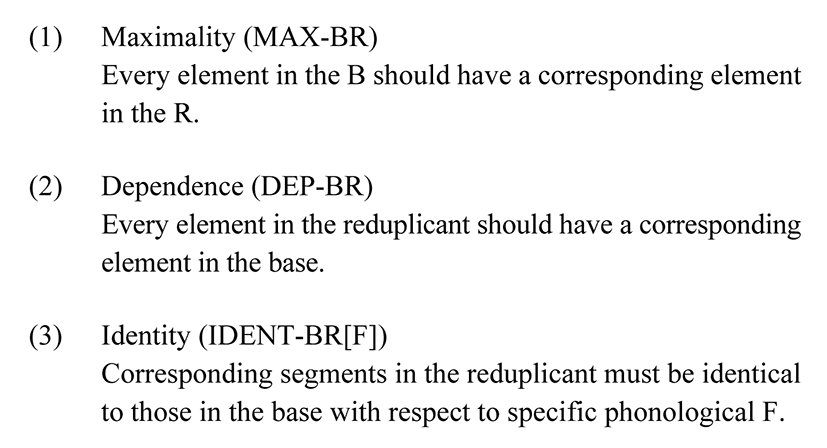
The interaction between these constraints provides a useful framework for studying and analyzing onomatopoeic expressions in Maithili and for depicting their interaction with reduplication, thereby unfolding the phonological structure underlying these expressions.
4. Onomatopoeia in Maithili
Maithili is an Indo-Aryan language originating in the north-eastern part of Bihar, India, and the Terai region of Nepal. It is known for its rich linguistic features, such as onomatopoeia and reduplication, which are widely prevalent in the language (Asad 2015). Bangla is also an Indo-Aryan language that shares systematic linguistic features with Maithili (Kar 2012). We observe that Bangla has seen a fair amount of literature concerning syllable structure and other linguistic features, including voicing agreement (Kar 2012; Kar and Truckenbrodt 2019). Onomatopoeia in Bangla also adds to the lexicon’s diversity within the family of Bengali languages, unlike in Maithili (Thompson 2020).
The creation of words that imitate natural sounds, such as onomatopoeia and reduplication, is of great importance to Maithili’s vocabulary. For example, in Maithili, the word /bʰɔ̃k/ is used to imitate a dog’s bark, while /ʤʰənʤʰən/ is used for the jingling sound of bells. The high prevalence of onomatopoeic words in Maithili suggests that the speakers are very willing to capture the auditory elements of their environment. It plays an important role in everyday speech. Abbi (1992) has listed acoustic noises under the term “expressive,” which is considered an onomatopoeia in this study. Abbi (2018) discusses expressives from the perspective of reduplication, which is widely prevalent in South Asian languages compared to non-reduplicated languages. However, note that each is a unit lexeme and a single structural category, whether reduplicated or non-reduplicated. Nearly all expressives are formed by repeating a meaningless syllable. The structure formed after repeating a meaningless syllable constitutes a single morpheme and a single lexeme in that language. Expressive forms attain the status of lexemes when duplicated; however, although relatively few in number, non-reduplicated expressives also exist in Naga languages (Abbi 2018), and a similar pattern is observed in Maithili.
Onomatopoeic expressions in Maithili can be categorized according to their morphological structure. The data collected for this study reveal that these expressions occur in different structural patterns depending on whether reduplication is involved. In some cases, the sound-imitating word occurs independently, while in others it interacts with reduplication, either fully or partially. Based on these structural patterns, the onomatopoeic expressions observed in the dataset are classified into three broad categories: independent onomatopoeia, complete reduplicated onomatopoeia, and partial reduplicated onomatopoeia. The following subsections describe each of these categories with examples from Maithili.
Independent onomatopoeia refers to sound-imitative expressions that occur without reduplication. These forms function as independent lexical items and directly imitate natural sounds (Table 1).
These expressions imitate sounds directly and do not involve any repetition or phonological alternation.
Complete Reduplicated Onomatopoeia involves the full reduplication of a base word to imitate natural sounds, contributing to the expressive nature of the language (Pathak, Nandi, and Sarmah 2022). In this structure, the entire base is copied, creating a meaningful term, whereas when not reduplicated, the base itself often lacks meaning (Table 2).
These expressions enhance the auditory effect and often represent continuous or repetitive sounds.
Partial Reduplicated Onomatopoeia involves the partial reduplication of a word, where the repeated element undergoes some phonological alteration (Pathak, Nandi, and Sarmah 2022). These alternations may involve consonant change, vowel change, or vowel insertion. In Maithili, as in Assamese (Pathak, Nandi, and Sarmah 2022), the base forms of these onomatopoeias are meaningless and acquire meaning only through partial reduplication. In this process, a segment of the base word is repeated to emphasize or intensify the onomatopoeic effect (Table 3).
These forms illustrate how partial reduplication creates rhythmic sound patterns that enhance the expressive nature of onomatopoeic expressions in Maithili.
The tables presented above demonstrate that onomatopoeic expressions in Maithili occur in multiple structural forms. Some expressions exist independently without reduplication, while many interact with reduplication, either completely or partially. Among these categories, complete reduplicated onomatopoeia appears to be prominent in the dataset. This categorization provides a clear understanding of the interaction of onomatopoeia and reduplication, which is examined in detail in the following section.
Despite differences in their primary functions and forms, both enhance the emotive and expressive power of language. Reduplication reflects a significant number of modifications towards a word, whereby one repeats the word or a specific part of the word to obtain new lexical or grammatical aspects of the word form (Rubino 2005). The term Onomatopoeia describes words that represent the sounds they denote, such as the noise of animals. Reduplication and Onomatopoeia together have an enhanced impact on language, as they involve sounds and sequenced elements. They tend to replace simple phrases and words with vivid, active ones. A prominent area where reduplication and onomatopoeia coincide is the formation of words that imitate sounds with a repetitive or excessive accent.
This interaction can be observed in several languages. In English, many sound-symbolic expressions show reduplicative patterns that imitate rhythmic or repetitive sounds (Table 4).
| No. | Onomatopoeic Form | Meaning |
|---|---|---|
| 1 | tick-tock | sound of a clock |
| 2 | flip-flop | sound of sandals while walking |
| 3 | zig-zag | irregular or repeated movement |
| 4 | ding-dong | sound of a bell |
In the above examples from English, we can see that the base and the reduplicant together give rise to an onomatopoeic expression in which the base is reduplicated and accompanied by a vowel change. These examples show that repetition of phonological elements can effectively mimic the rhythmic nature of sounds in the environment. Hence, the interaction between reduplication and onomatopoeia is very much evident in the above examples.
A similar interaction between reduplication and sound imitation can also be observed in other languages. For instance, in Japanese, iconic expressions occur frequently in conversation, especially in informal conversation; they are widely used in newspapers and magazines, in most forms of advertising, and in literature, from children’s stories, where they are used lavishly, to popular novels (Table 5). Facility in using such forms to express subtle gradations of expressive meaning is widely recognized as a mark of fluency (Kakehi, Tamori, and Lawrence 1996).
| No. | Onomatopoeic Form | Meaning |
|---|---|---|
| 1 | doki-doki | sound of a heartbeat |
| 2 | aha-aha | sound of loud laughter |
| 3 | bacha-bacha | repeated large splashing sound |
| 4 | bachi-bachi | loud slapping sound |
Not only Japanese but also other languages show the interaction between reduplication and onomatopoeia. It is also observed in Swahili. We can see several examples of ideophones in Swahili, where they are formed by reduplication (Lusekelo 2013; see Table 6).
| No. | Onomatopoeic Form | Meaning |
|---|---|---|
| 1 | ndondondo | water drip |
| 2 | ngongongo | sound of knocking at the door |
| 3 | ndembe ndembe | completely (soft, wet) |
| 4 | nyan'ganyan'ga | completely, totally (torn, destroyed) |
After discussing cross-linguistic patterns in English, Japanese, and Swahili, we now turn to Maithili data to examine how onomatopoeic expressions interact with reduplication in this language.
The analysis of onomatopoeic expressions in Maithili reveals that they frequently interact with reduplication (Table 7). There are three patterns of interaction found between onomatopoeia and reduplication in Maithili: onomatopoeia with complete reduplication (completely), partial reduplication (partially), and onomatopoeia without reduplication (null).
To calculate the frequency of all the types of onomatopoeic expressions, we took a total of 64 instances of onomatopoeic expressions. Their frequency distribution is calculated and shown below.
Table 8 shows that the complete reduplicated onomatopoeia is the most frequent pattern found in Maithili. It shows that copying the base form plays a central role in the formation of onomatopoeic expression. Partial reduplicated onomatopoeia with C and V variation and independent onomatopoeia occur less frequently, and hence they are marked but still contribute to the expressive richness of the language.
| Type of Onomatopoeia | Percentage (%) |
|---|---|
| Complete reduplicated onomatopoeia | 87.1 |
| Partial reduplicated onomatopoeia | 8.1 |
| Independent onomatopoeia | 4.8 |
The analysis presented above shows that onomatopoeic expressions in Maithili are of different types, occur in various structural patterns, and frequently interact with reduplication. To examine these patterns and their phonological characteristics, it is important to discuss the methodology used in this study. The following section, therefore, describes the adopted methodology for examining onomatopoeic expressions in Maithili.
5. Methodology
This section discusses in detail the methodologies used to examine onomatopoeia in Maithili. This study uses qualitative research methods. However, the frequency counts are also calculated to show which type of onomatopoeic expressions are unmarked and which ones are marked. We also see the interaction of these expressions with reduplication. The data collected for this study are a mix of primary and secondary data. Primary data were collected in the field in the Darbhanga and Madhubani districts of Bihar, India, whereas a raw corpus of Maithili served as the secondary data source
The methods of data collection consisted of structured and semi-structured interviews. Native speakers from diverse social backgrounds were interviewed to collect instances of onomatopoeic expressions in Maithili. Data collection took place in the natural setting, including homes, markets, and cultural events. It was done naturally, so we could gain insight into the spontaneous use of onomatopoeic expressions. Besides primary data, secondary data were also collected from sources such as existing literature, including previous research studies (e.g., Asad 2015) on reduplication in Maithili, as well as comprehensive grammars of Maithili, which provide instances of onomatopoeic expressions. Maithili literature, which includes poetry, folk songs, and prose, was also analyzed. Raw speech corpus was also retrieved from LDCIL (CIIL, Mysore, India). Collectively, they were the secondary sources of data. The collected instances were further analyzed using thematic analysis to identify patterns and themes related to the use of onomatopoeia (Braun and Clarke 2006).
A thorough morphological analysis was conducted in order to understand the structure of reduplicative and onomatopoeic expressions. The forms of complete and partial reduplication, as well as their role, were examined in the study of onomatopoeic expressions (Rubino 2005). The frequency of different categories of onomatopoeic and reduplicative expressions was calculated to determine how frequently they occur in spoken and written Maithili. Counting frequency involved counting the occurrences of these expressions in the collected data and then calculating their percentages. The interviews were audio-recorded with the participants’ consent. Respondents were assured of the confidentiality and anonymity of their responses (Rubino 2005). The frequency of different categories of onomatopoeic and reduplicative expressions was calculated to determine how frequently they occur in spoken and written Maithili. Counting frequency involved counting the occurrences of these expressions in the collected data and then calculating their percentages.
After transcribing the data, the onomatopoeic expressions were analyzed using correspondence theory, a sub-theory within Optimality Theory.
6. Findings and Discussions
After investigating onomatopoeic expressions in Maithili, it is evident that they are highly prominent in the language. This section presents qualitative analyses of onomatopoeic expressions, along with their frequency distributions. To investigate this phenomenon, its frequency is calculated. Not only the frequency, but also the syllable patterns and their semantic functions are considered. A close look at the data reveals a significant variation in the frequency distribution of onomatopoeic forms in Maithili. Sixty-four instances were extracted for the analysis. Firstly, all instances are categorized into three types: complete reduplicated onomatopoeia, partial reduplicated onomatopoeia, and independent onomatopoeia. In most cases (54 instances), the onomatopoeia falls into the category of complete reduplicated onomatopoeia. Approximately 87% of the data consists of completely reduplicated onomatopoeia. Independent onomatopoeias account for 8.1 percent, such as partially reduplicated onomatopoeias. This was about the frequency parameter. Next comes the turn of the syllabic pattern. Most of it is of a CVC sequence (A vowel preceded and succeeded by a consonant). The above findings were based on qualitative analysis supplemented by descriptive frequency counts. The qualitative analysis explores the semantic aspect of onomatopoeia. The interaction between reduplication and onomatopoeia is evident when their frequency counts are considered. Complete reduplicated onomatopoeia is the most unmarked type of onomatopoeia. Instances of it are /gʰəʈ-gʰəʈ/ and /ʤʰɪhɪr-ʤʰɪhɪr/, where there is a complete reduplication of either of the sides of onomatopoeia. Here, it often conveys a sense of continuity or intensity. Though less common, partial reduplicated onomatopoeia introduces variation by repeating only part of the word. We observe some alternations in the consonants or vowels. Instances of it are /ʧʰənən-mənən/ and /ʧʰək-ʧʰʊk/. In /ʧʰənən-mənən/, we see the alternation in a consonant, and in /ʧʰək-ʧʰʊk/, an alternation is observed in a vowel. The auditory image created by partial reduplicated onomatopoeia is a bit more complex compared to complete reduplicated onomatopoeia. Independent onomatopoeias, such as /dʰəp/ and /pʰətaːk/, are the third category of onomatopoeia, which exists independently, irrespective of any interaction with the reduplication. Semantically, Maithili onomatopoeia effectively reflects the sounds associated with the actions it describes, providing a direct auditory link to its meaning. The frequent use of complete reduplication shows its importance in conveying continuous or intense sounds, while partial reduplication, together with independent lexemes, provides specific and varied auditory imagery. The dataset was analyzed using OT. The initial task was to identify the constraints governing Maithili onomatopoeia and then to establish a ranking of these constraints using the framework proposed by McCarthy and Prince (1995). The phonology or well-formedness rules come between the faithfulness constraints determined after scrutinizing the entire dataset. The faithfulness constraints that play a role in the analysis of onomatopoeic expressions in Maithili are MAX-BR and IDENT-BR.
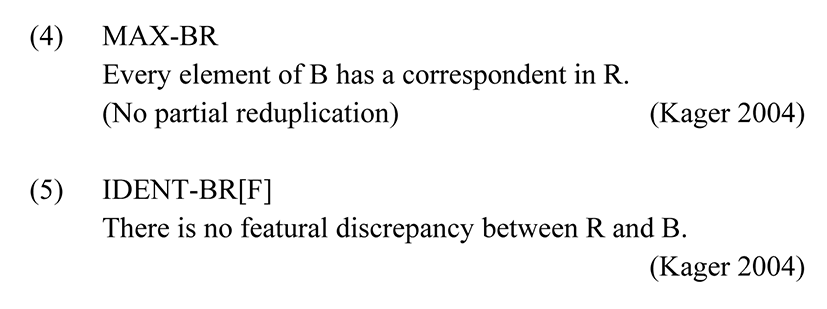
This section presents the analysis for each type of onomatopoeia that intersects reduplication. Two kinds of onomatopoeia have already been discussed in the earlier section: complete reduplicated onomatopoeia and partial reduplicated onomatopoeia. Tableaus are presented in this section for each type of onomatopoeia, with explanations provided below each tableau.
In Table 9, candidate (c) appears to be the optimal choice since it does not incur any constraint violations. However, this form [ʈən-pən] is not attested in Maithili. This indicates the need for phonotactic conditions to rank constraints in Maithili’s onomatopoeic expressions. Upon analyzing the dataset of onomatopoeias in Maithili, it becomes clear that the onset of the reduplicant typically matches the base onset or begins with /m/ or /t/. Therefore, Table 9 is revisited with the phonotactic patterns of Maithili in mind. The updated analysis is presented in Table 10, reflecting the revised constraint ranking for complete reduplicated onomatopoeias in Maithili.
| tən-RED | MAX-BR | IDENT-BR |
|---|---|---|
| ☹ (a) ʈən-ʈən | * | |
| (b) ʈən-ən | *! | |
| 💣 (c) ʈən-pən |
| ʈən-RED | MAX-BR | RED Onset t/m | IDENT-BR |
|---|---|---|---|
| ☞ (a) ʈən-ʈən | |||
| (b) ʈən-ən | *! | ||
| (c) ʈən-pən | *! |
In Table 10, the reduplication of the base ʈən, representing the sound of a bell ringing once, is evaluated to identify the optimal candidate based on the constraints MAX-BR, RED Onset t/m, and IDENT-BR. The first candidate, [ʈən-ʈən], duplicates the base without modification, preserving all its elements in the reduplicant. This satisfies the MAX-BR constraint, as no sound is deleted. Since there is no alternation in the onset, it also meets the RED Onset t/m constraint. Furthermore, as the reduplicant is identical to the base, the IDENT-BR constraint is also fulfilled. As a result, [ʈən-ʈən] does not violate any constraints and is selected as the optimal candidate. The second candidate, [ʈən-ən], fails to preserve the onset of the base in the reduplicant, violating the highest-ranked constraint, MAX-BR, which disqualifies it as the optimal candidate. The third candidate, [ʈən-pən], alters the onset of the reduplicant by replacing /t/ with /p/, violating the RED Onset t/m constraint, which specifies that the onset of the reduplicant must begin with either /t/ or /m/ in onomatopoeic expressions. This violation makes [tən-pən] suboptimal. Thus, [ʈən-ʈən] is identified as the optimal output, as it satisfies all relevant constraints without incurring any violations. The proposed constraint for this category of reduplication is RED Onset t/m:

Following the tableau analysis for complete reduplicated onomatopoeia, the following section outlines the three sub-categories of partial reduplication in onomatopoeia. The first sub-category involves a change in the consonant at the onset position. The second sub-category focuses on vowel alternation. The third and final sub-category examines partial reduplication with vowel epenthesis.
Tableau in Table 11 examines partial reduplication in onomatopoeia, focusing explicitly on cases where the consonant at the onset position changes. The input is /ʧʰən/, representing an onomatopoeic sound. The tableau evaluates three candidates against the constraints MAX-BR, RED Onset t/m, and IDENT-BR. The optimal candidate, [ʧʰən-mən], satisfies the key constraints. Although it incurs a violation of IDENT-BR due to the onset change from /ʧʰ/ to /m/, it complies with the RED Onset t/m constraint, which allows or even expects such a change in the onset for onomatopoeic expressions as long as the new onset is /t/ or /m/. The candidate also respects MAX-BR by preserving all other segments of the base. As a result, despite the minor violation of IDENT-BR, [ʧʰən-mən] is selected as the optimal candidate. The second candidate, [ʧʰən-ən], violates the MAX-BR constraint because the onset of the base /ʧʰ/ is not preserved in the reduplicant. This fatal violation disqualifies it as an optimal candidate. The third candidate, [ʧʰən-ʧʰən], maintains identical segments in both the base and the reduplicant, thereby satisfying IDENT-BR and MAX-BR. However, it violates the RED Onset t/m constraint because the reduplicant does not exhibit the expected onset change to /t/ or /m/. This violation renders [ʧʰən ʧʰən] suboptimal. Consequently, [ʧʰən-mən] emerges as the optimal output, as it best aligns with the constraints despite the minor violation of IDENT-BR.
| ʧʰən-mən | MAX-BR | RED Onset t/m | IDENT-BR |
|---|---|---|---|
| ☞ (a) ʧʰən-mən | * | ||
| (b) ʧʰən-ən | *! | ||
| (c) ʧʰən-ʧʰən | *! |
Table 12 examines the partial reduplication of the base ʈən in an onomatopoeic context, with a focus on vowel alternations. The candidates compete against these three constraints: MAX-BR, RED Onset t/m, and IDENT-BR. The winning candidate is [ʈən- ʈʊn], which is an alternation in the vowel and, therefore, partial reduplication. In candidate a, the onset /t/ is preserved, but the vowel changes from /a/ in the base to /u/ in the reduplicant. This vowel change violates the IDENT-BR constraint, which states that the base and reduplicant should be identical in their segments. However, it satisfies the MAX-BR constraint by reduplicating the onset and coda of the base. It also meets the RED Onset t/m constraint, as the onset of the reduplicant remains /t/, one of the allowed onsets according to the proposed markedness constraint. Despite the vowel change, the candidate [ʈən-ʈʊn] is selected as the optimal output because it adheres to the higher-ranked constraints. The second candidate, [ʈən-ən], fails to preserve the onset of the base in the reduplicant, thereby violating the MAX-BR constraint, which leads to its disqualification. It also violates the RED Onset t/m constraint, as the onset of the reduplicant is not /t/ or /m/, making it even less optimal. The third candidate, [tan-pan], maintains the original vowel /a/, satisfying IDENT-BR. However, it violates the RED Onset t/m constraint, as the reduplicant’s onset is /p/rather than the expected /t/ or /m/, rendering it suboptimal. Consequently, the candidate [ʈən-ʈʊn] was chosen as the optimal output, as it strikes the best balance between the constraints, even with a minor violation of IDENT-BR.
| ʈən-RED | MAX-BR | RED Onset t/m | IDENT-BR |
|---|---|---|---|
| ☞ (a) ʈən-ʈʊn | * | ||
| (b) ʈən-ən | *! | * | |
| (c) ʈən-pən | *! |
In Table 13, we evaluate the reduplication of the form ʈən, representing the sound of hitting sharply. The reduplicated forms are evaluated based on constraints to determine the optimal output. The input is ʈən-RED, where RED indicates the reduplicant, and various candidate forms are compared.
| ʈən -RED | MAX-BR | RED Onset t/m | *RED [+cons] | RED ≤σ | IDENT-BR |
|---|---|---|---|---|---|
| ☞ (a) ʈən-a-ʈən | * | * | |||
| (b) ʈən-ən | *! | * | * | ||
| (c) ʈən-pən | *! | * | * | ||
| (d) ʈən- ʈən | *! | ||||
| (e) ʈən- ʈʊn | *! | * |
The first constraint, MAX-BR, requires that the reduplicant be entirely faithful to the base, meaning no segments should be deleted when copying the base. The second constraint, RED Onset t/m, specifies that the reduplicant must have either /t/ or /m/ as its onset, enforcing a strict requirement for the initial consonant in the reduplicant. The third constraint, *RED [+cons], penalizes the presence of onset consonants in the reduplicant, encouraging forms where the reduplicant either lacks an onset or begins with a vowel. The fourth constraint, RED ≤ σ (Kim 1997), requires that the reduplicant is at most a single syllable. The final constraint, IDENT-BR, ensures that the reduplicant and the base maintain identical phonological features, especially for place and manner of articulation.
The first candidate, ʈən-a-ʈən, consists of a reduplicant with an intervening vowel between two repeated elements. This form violates *RED [+cons]. The reduplicant contains consonants (which the constraint discourages) and RED ≤ σ because the reduplicant is longer than one syllable. However, this candidate satisfies the other essential constraints, such as MAX-BR, because no segments are deleted from the base, RED Onset t/m, since the onset of the reduplicant is /ʈ/, and IDENT-BR, as it preserves the features of the base.
The second candidate, [ʈən-ən], simplifies the reduplicant by omitting the initial consonant, making it violate MAX-BR, as the onset /ʈ/ is deleted from the base. It also violates IDENT-BR because the reduplicant is not identical to the base regarding its phonological features. However, this form satisfies *RED [+cons], as it lacks a consonantal onset and adheres to RED ≤ σ, within the one-syllable limit.
The third candidate, [ʈən-pən], introduces a different onset consonant /p/, which violates RED Onset t/m because the onset is not one of the specified consonants /t/ or /m/. This candidate, though, satisfies MAX-BR, *RED [+cons], and RED ≤ σ, but its failure to meet the onset requirement makes it a less optimal choice.
The fourth candidate, [ʈən-ʈən], exactly repeats the base. While this candidate violates *RED [+cons] (because the reduplicant has a consonant onset), it satisfies MAX-BR, RED Onset t/m, and IDENT-BR. Although this candidate does well overall, its violation of *RED [+cons] lowers its ranking, given the preference for avoiding consonants in the reduplicant.
The fifth candidate, [ʈən-ʈʊn], modifies the vowel of the reduplicant, violating IDENT-BR because the reduplicant does not preserve the vowel of the base. Like the previous candidates, it violates *RED [+cons] but satisfies MAX-BR, RED Onset t/m, and RED ≤ σ. The candidate a, ʈən-a-ʈən becomes the optimal candidate, despite its violations of the constraints *RED [+cons] and RED ≤ σ. It satisfies the faithfulness constraints MAX-BR, which avoids deletion, and the markedness constraint RED Onset t/m, which imposes a specific consonantal onset. The other candidates, particularly [ʈən-ən] and [ʈən-pən], violate higher-ranked constraints, such as MAX-BR and RED Onset t/m, and are therefore eliminated from the list of likely optimal candidates.
The tableaux in this study provide an in-depth investigation of the categories of onomatopoeic expressions that intersect reduplication, particularly complete and partial reduplication patterns. The constraints which interact with each other are MAX-BR, RED Onset t/m, IDENT-BR, *RED [+cons], and RED ≤ σ. In the case of complete reduplication, as shown in the tableau above, the optimal candidate fully copies the base without any violations, indicating that complete preservation of the base is the preferred option.
However, in the context of partial reduplication, specific phonological processes, such as onset alternation and vowel epenthesis, are observed. The proposed constraint RED Onset t/m plays a crucial role in choosing the optimal candidates in cases of partial reduplication. This constraint requires the onset of the reduplicant to be /t/ or /m/, which represents a language-specific pattern in onomatopoeic expressions. Despite violating lower-ranked constraints like IDENT-BR, candidates that stuck to the constraint RED Onset t/m were generally favored as optimal outputs. Additionally, the analysis of vowel epenthesis in reduplication revealed that while the insertion of a vowel may lead to violations of IDENT-BR and increase the number of syllables, such epenthesis is sometimes required to meet higher-ranked constraints, such as MAX-BR and RED Onset t/m. The other constraints, such as *RED [+cons] and RED ≤ σ, state that the language also imposes structural requirements on reduplication.
The findings suggest that while the language allows for some degree of phonological flexibility in reduplication, it strongly favors candidates that maintain the integrity of the base and adhere to specific phonotactic patterns, particularly in the onset position. This analysis explains onomatopoeic reduplication and how phonological constraints interact in this linguistic context. Further research could be comparing the observed patterns with onomatopoeic data from other languages to explore universal vs. language-specific trends in sound symbolism.
7. Conclusion
The present study of onomatopoeia in Maithili, focusing on reduplication, provides an in-depth analysis of the interaction between sound symbolism and morphological processes. The findings reveal that onomatopoeic expressions, which represent natural sounds, interact with reduplication, a linguistic phenomenon in Maithili. The majority of onomatopoeic expressions in the language are formed through complete reduplication, in which the base is fully copied, which conveys the intensity and continuity of the action being described. The complete reduplicated onomatopoeia accounts for 87.1% of the data, underscoring its dominance over partial reduplication and independent onomatopoeia. Partial reduplicated onomatopoeia involves modifications in the copied segment. Lastly, independent onomatopoeia is that which mimics natural sounds but exists independently. The use of reduplication enhances the rhythmic quality of the language. It intensifies the sensory imagery attested with natural sounds. These onomatopoeic expressions contribute to the linguistic richness of Maithili, enhancing communication. It also explains how the interaction of faithfulness and markedness constraints, particularly those derived from Correspondence Theory within the framework of Optimality Theory, governs the formation of onomatopoeic expressions in Maithili. The study illustrates the interaction between faithfulness constraints, such as MAX-BR, which states that segments are preserved in the reduplicant, and well-formedness constraints, such as RED Onset t/m, which stipulates that the onset of the reduplicant is t/m. Their interaction highlights the balance between maintaining the integrity of the base word and allowing for phonological flexibility in reduplication. Overall, the research shows the complex relationship between sound and meaning in Maithili. The interaction shows how we perceive and produce natural sounds. It enhances everyday communication and the linguistic and cultural richness of the Maithili-speaking community. This study offers an in-depth understanding of sound symbolism and morphological processes, such as reduplication, and how they interact to create meaning across languages.


