
 PDF Download
 PubReader
 Export Citation
 Email the Author
 Share Facebook
 Share Twitter
 Cited by 0 Article
 Metrics (View:92)






1. Introduction
Lexical typology examines how languages structure semantic domains through their lexicons and how comparable experiential realities are distributed across distinct lexical categories. Rather than presupposing that translation equivalents reflect identical conceptual structures, lexical typology investigates the internal organisation of lexical systems: which distinctions are lexically encoded, which are conflated, and how semantic contrasts are distributed across individual lexical items (Koptjevskaja-Tamm 2008, 2012; Koptjevskaja-Tamm, Rakhilina, and Vanhove 2016). The central concern is therefore not simply cross-linguistic difference, but the structural architecture of lexical meaning within and across languages (Talmy 2000, 2007).
Events of physical separation (cutting, splitting, and breaking) constitute a particularly productive domain for such inquiry. These events arise from shared bodily interaction with material objects, yet languages differ systematically in how they encode distinctions relating to instrumentality, force dynamics, internal structural organisation, and result configuration. Cross-linguistic research, most prominently Majid et al. (2007), has demonstrated that languages vary in how they categorise separation events: some maintain distinct lexical classes for incision, splitting, and fracture, whereas others group configurations that English lexicalises separately.
However, much of this research has compared category systems at a relatively coarse grain, asking which distinctions languages lexicalise at all. Less attention has been paid to pairs of languages that share a category inventory yet place the internal boundaries of those categories differently. The cutting–breaking domain provides a controlled testing ground for locating precisely where such boundaries fall within a shared conceptual space.
At the same time, research on event structure and verb classification has emphasised the interaction between manner and result components in verb meaning (Levin 1993; Rappaport Hovav and Levin 2010; Talmy 2000). The principle of manner and result complementarity (Rappaport Hovav and Levin 2010) proposes that lexical verbs tend to encode either the manner of action or the resulting state, but not both simultaneously in equal prominence. The cutting–breaking domain is particularly relevant in this respect, as incision verbs foreground manner of force application, fracture verbs foreground result state, and splitting verbs integrate structurally guided propagation with a binary outcome. Examining how languages distribute these event components across lexical items offers insight not only into how manner and result are encoded, but also into how finely such components are lexically differentiated within a semantic field.
Despite the typological relevance of separation events, Turkic languages, and Uzbek (the language of Uzbekistan) in particular, remain under-represented in domain-based lexical-typological research. This gap limits our understanding of how lexical partitioning operates in languages outside the Indo-European family and constrains broader comparative generalisation. The present study addresses this gap through a systematic comparison of Uzbek and English in the domain of physical separation events. The Uzbek cutting–breaking verbs have not previously been documented in this framework; in this respect the study joins recent descriptive work on how under-represented languages organise particular lexical domains (Alphonce 2023).
The analysis is restricted to a narrowly delimited domain: the intentional separation of solid inanimate objects through force, resulting in division into two or more parts. Tearing of flexible materials, pulverisation, and metaphorical or abstract extensions are excluded in order to maintain semantic control. Rather than relying on gloss-based equivalence, the comparison proceeds by examining verb behaviour across controlled contextual parameters, including material compatibility, instrument type, force dynamics, and result configuration. The guiding research question is how Uzbek and English distribute semantic distinctions within this domain and where each language places the boundaries of the resulting lexical categories.
The analysis argues that both languages encode the same macro-event categories (incision, structural splitting, and fracture) and therefore do not differ in granularity at the level of category inventory; their differences lie in where each language places the boundaries of these categories.
The notion of granularity used here derives from work on grain-dependent representation (Hobbs 1985) and, in lexical typology, from Evans’s (2011) account of three axes along which languages categorise a domain: granularity (the number of distinct categories), boundary location (where the dividing lines fall), and grouping and dissection (membership criteria). We use granularity in this first, count-based sense: a language is more granular in a domain when it lexicalises configurations as distinct conventional verbs that another subsumes under one verb. Lexical density is the operational measure: the ratio of distinct lexical items to independently distinguishable configurations within the delimited domain. Lexical compression names its low pole. The three terms are thus not independent: density is the measure, granularity and compression its poles. This domain-partitioning sense should be distinguished from the granularity of senses within a single lexeme familiar from computational lexical semantics (fine- vs. coarse-grained word senses); our concern is the partition of a domain across lexemes.
A compressing verb is simply one that is general, or underspecified, relative to the distinctions a comparison language lexicalises separately: where Uzbek uses two verbs, the corresponding English verb is broader, and its narrower construals are recovered through context or marking. Granularity and compression are therefore comparative descriptors over lexical partitions, a cross-linguistic restatement of the familiar relation between a general lexeme and the more specific configurations it can denote (Mani 1998); they are not additions to the semantic ontology.
From the perspective of decompositional approaches such as the Natural Semantic Metalanguage framework (Goddard 2012), lexical contrasts may be modelled in terms of distinct semantic templates built from universal primes. The axes examined here operate at a different level: rather than decomposing individual lexemes, they concern how a shared domain is partitioned across lexical items and where the resulting category boundaries fall. Methodologically, the study relies on tightly delimited domain-based comparison, in which language-internal analysis precedes cross-linguistic alignment; the value of this design is taken up in the concluding discussion.
The study is deliberately limited to two languages in order to permit fine-grained structural analysis within a tightly controlled domain. The aim is not large-scale typological generalisation, but analytical precision in identifying how lexical partitioning operates in distinct linguistic systems. The Uzbek–English comparison thus serves not only as an empirical case study, but also as a controlled demonstration of boundary location as a locus of systematic divergence between lexicons that share a category inventory. The study is contrastive, covering two languages, rather than typological in the sampling sense (cf. Baymot 2025 for a comparable two-language design contrasting an under-described language with English); broader cross-linguistic testing is left to future work.
2. Domain Delimitation and Method
The study adopts a domain-based lexical-typological approach in the sense of Koptjevskaja-Tamm (2008, 2012), whereby analysis proceeds from explicit semantic delimitation to systematic language-internal structural examination prior to cross-linguistic comparison. This design enables fine-grained observation of how semantic distinctions are distributed across lexical items within a controlled domain. Rather than starting from translation equivalents, the method identifies a narrowly defined conceptual domain and investigates how each language partitions that domain through its lexical resources. This procedure avoids gloss-based comparison and instead focuses on the internal organisation of lexical contrasts. The approach is also compatible with frame-based models of lexical semantics (Rakhilina and Reznikova 2014), which treat lexical meaning as emerging from recurrent event configurations and distributional constraints revealed through systematic contextual comparison.
The domain investigated comprises events in which force is applied to a solid inanimate object, typically by an intentional agent, resulting in its separation into two or more parts. The analysis excludes: (i) tearing of flexible materials (e.g., cloth or paper); (ii) crushing or pulverisation into particulate matter; and (iii) metaphorical or abstract extensions (e.g., breaking a promise, cutting expenses). These exclusions maintain semantic control and ensure comparability across languages. The focus is restricted to concrete physical-separation events involving bounded objects and observable result states.
The Uzbek verbs examined are: kesmoq “cut”; qirqmoq “trim or cut with scissors”; yormoq “split”; sindirmoq “break (transitive)”. The English verbs analysed are: cut; split; break. These verbs were selected because they constitute structurally central lexical items within the cutting–breaking domain in each language.
Both languages have further, more specialised incision verbs beyond this core set: English chop, slice, carve, and trim; Uzbek likewise to’g’ramoq, arralamoq, and others. These are set aside to keep the comparison on the default verbs selected in neutral contexts, not because either language leaves the incision domain internally undifferentiated. Trim is retained in the discussion, however, because it bears directly on the status of qirqmoq.
The focus is restricted to high-level verbs that organise the primary lexical partitioning of the domain rather than its more fine-grained manner elaborations. This restriction ensures that observed contrasts reflect core lexical partitioning rather than peripheral manner specialisation. While each verb exhibits broader polysemy outside the restricted domain, only its concrete physical-separation senses are considered here.
Verb centrality was determined according to three criteria: (i) status as a basic verb in standard Uzbek and English; (ii) high frequency and conventional use in neutral, non-specialised contexts; (iii) coverage of a distinct macro-event configuration within the restricted domain. By structurally central we mean verbs satisfying criteria (i)–(iii); these are adapted from the tradition of identifying basic vocabulary in a domain (cf. Berlin and Kay 1969 on basic colour terms). High-level and primary are used as informal equivalents of central, not as technical labels.
Highly technical, dialectal, or idiomatic expressions were excluded. Sindirmoq is a lexicalised causative and is included on this basis. In Uzbek, parchalamoq “fragment” and maydalamoq “crush” were excluded as extending beyond the restricted domain (fragmentation, pulverisation); parchalamoq was excluded on this basis, not because it is derived. Bo’lmoq “divide”, by contrast, falls within the domain, since it is the default verb for concrete binary division (qog’ozni ikkiga bo’ldi “divided the paper in two”) but it is manner-neutral: it entails separation into parts without specifying how. It therefore serves as the result-pole hyperonym (cf. English divide) against which the manner-specifying verbs are defined, and is discussed in that role rather than as one of them.
A full list of candidate verbs considered during delimitation is provided in Table A1. This procedure ensures that “granularity” is assessed relative to structurally central verbs rather than peripheral items.
The inclusion of both kesmoq and qirqmoq reflects an observed subdivision within incision-based events in Uzbek. English subdivides the same domain through trim, which likewise isolates a reduction-oriented incision distinct from general cutting. Both languages thus differentiate the incision domain below the level of the general verb, though, as discussed below, qirqmoq and trim do not draw that internal boundary along the same parameter. The verb sets are therefore not treated as translation equivalents but as language-internal nodes within the relevant semantic field.
The analysis is based on: (i) consultation of authoritative monolingual dictionaries in both languages; (ii) examination of attested usage examples in lexicographic sources; and (iii) native-speaker judgments regarding typical usage contexts, material compatibility, instrument requirements, and result interpretation. Native-speaker consultation was used to determine unmarked verb choice in neutral contexts (e.g., manual division of bread), ensuring that observed contrasts reflect conventional lexicalisation rather than isolated usage variation.
Uzbek distributions were cross-checked through consultation with five senior scholars in philological sciences (PhD and DSc level) affiliated with Uzbek National Universities, in addition to the author’s native-speaker competence. Lexical definitions and usage patterns were verified against O’zbek tilining izohli lug’ati (Explanatory dictionary of the Uzbek language).
For English, the study draws on the extensive existing analysis of the cutting–breaking domain rather than fresh elicitation: verb-class membership follows Levin (1993) and the cross-linguistic cutting–breaking literature (Majid et al. 2007), with definitions and usage verified against Merriam-Webster. This asymmetry in data collection is principled: Uzbek cutting–breaking verbs are largely undescribed and require primary native-speaker elicitation, whereas the English verbs are extensively documented and their partition can be established from the published record. Both partitions are therefore independently grounded, Uzbek through elicitation and English through established lexical-semantic analysis, rather than either being projected onto the other.
Where intuitions diverged or marginal cases arose, preference was determined based on consensus judgments regarding neutral, unmarked contexts. Consultations were conducted individually rather than in group discussion. Participants were presented with short standardised scenario descriptions (e.g., “manual division of bread without tools,” “snapping a dry twig,” and “cutting hair with scissors”) and asked to provide the most natural unmarked verb in neutral contexts. The scenario set instantiated the diagnostic cells described under Analytical Scope, together with the borderline cases discussed below. Judgments were recorded in written notes, and preference was determined on the basis of majority agreement. No cases of systematic disagreement remained unresolved. The aim was not to exhaust possible uses, but to identify default lexicalisation patterns within the controlled domain.
The study is qualitative in orientation. It does not provide corpus-based frequency counts or experimental elicitation data, nor does it aim at statistical generalisation. Instead, it relies on controlled contextual diagnostics to identify distributional constraints that reveal lexical partitioning patterns.
Consultants were senior philologists rather than a demographically diverse speaker sample because the verbs examined are basic, high-frequency items of standard Uzbek whose core physical-separation senses are stable across the standard variety, and because the task required consistent metalinguistic judgments of unmarked usage across controlled scenarios. This focus on the standard variety is a deliberate limitation: the findings concern standard Uzbek and do not claim to capture regional or colloquial variation, which remains a question for future work.
Methodologically, the comparison proceeds in two stages. The first stage consists of language-internal analysis, in which each system is examined independently to determine how distinctions relating to instrumentality, force dynamics, material properties, and result configuration are encoded. The second stage consists of structured contrastive comparison, in which these distributions are examined comparatively to identify systematic convergence and divergence.
Crucially, lexical items are not treated as directly comparable units. Rather, comparison is based on how verbs behave across controlled event parameters. Lexical meaning is therefore understood as emerging from patterns of contextual compatibility rather than from dictionary glosses alone.
Two of Evans’s (2011) axes are operationalised in this study. Granularity, as defined in the Introduction, is the count-based property of a domain’s lexical partition, measured by lexical density. Boundary location concerns where the dividing lines between lexicalised categories fall: two languages may share an inventory of categories while assigning borderline configurations to different categories, or while subdividing a shared category along different parameters. Both notions are analytical rather than quantitative, and they serve as tools for identifying structural asymmetries in lexical partitioning within a controlled domain.
Operationally, granularity is identified where (i) distinct event configurations can be isolated through independent diagnostics (instrument type, material compatibility, and result configuration), and (ii) these configurations correspond to distinct conventional lexical items rather than contextual variants of a single verb. In the present study, diagnostic cells are constructed by crossing force profile and result-state configuration within the restricted domain. A language exhibits higher granularity where multiple verbs occupy non-overlapping cells within this grid, whereas compression is observed when a single verb spans multiple configurational cells. Boundary location is identified where the two systems lexicalise a category over the same grid but assign a diagnostic configuration to different categories (manual division of bread: fracture in Uzbek, incision in English), or where the verbs subdividing a category are shown by the diagnostics to cross-cut rather than coincide (qirqmoq vs. trim).
A comparison between an agglutinative language and a largely analytic one raises the question of whether observed differences in lexical partitioning are artefacts of morphological type rather than of lexical semantics. Uzbek derivation can produce further separation verbs (e.g., parchalamoq “fragment”), and English compensates with phrasal and periphrastic resources (break apart, cut off, and split up), so an unconstrained comparison could mistake derivational capacity for semantic partitioning; morphological structure can shape the internal organisation of a lexical domain in its own right (cf. Ejeba 2025).
Three design decisions insulate the comparison from this confound. First, the Uzbek comparison set is restricted to basic, conventionalised verbs in standard Uzbek, and periphrastic items were excluded on both sides (Table A1), so no boundary claim rests on Uzbek’s derivational capacity. Second, sindirmoq is a lexicalised causative of sinmoq and is included on that basis; it is analysed as such: the transitivity alternation that English encodes through lability is treated as a difference in alternation marking (Haspelmath 1993), not in lexical partitioning. Third, the diagnostics compare the distribution of simplex verbs over controlled event configurations rather than inventory sizes, so a language’s capacity to coin additional verbs morphologically does not enter the measure. The boundary effects documented below (qirqmoq versus trim, split versus yormoq, the extension of sindirmoq to semi-rigid materials) concern where conventional simplex verbs apply, and are therefore not reducible to the agglutinative–analytic contrast.
3. Instrumentality, Event Structure, and Lexical Partitioning
The cutting–breaking domain in both Uzbek and English is structured around distinctions in manner of force application and result-state configuration. At a micro-level, both systems differentiate three event types: (i) incision, (ii) structurally guided splitting, and (iii) fracture. These distinctions are well established in cross-linguistic research on separation events (Majid 2015; Majid et al. 2007) and in analyses of English verb classes (Levin 1993). The contrast examined here does not concern the availability of these event schemas, but rather where each system places the internal boundaries of the corresponding lexical categories.
The following sections take each macro-type in turn (incision, splitting, and fracture) to locate where the two systems converge and where their lexical boundaries diverge. The three macro-event types are distinguished by independent diagnostic criteria: incision involves instrument-mediated penetration without inherent structural guidance; splitting involves force propagation along a salient structural axis yielding two substantial parts; fracture involves loss of structural integrity without entailed preservation of coherent parts. These diagnostics are applied consistently in the analysis below.
The Uzbek system was examined independently, through native-speaker elicitation, to determine its own internal contrasts; the English partition was established separately from the documented record (Levin 1993; Majid et al. 2007). The comparison therefore aligns two independently sourced partitioning systems, neither projected onto the other, within a shared semantic domain.
In English, incision events are primarily lexicalised by cut. Semantically, cut profiles an event in which force is applied via an edged implement, resulting in penetration and separation of the affected object. In Levin’s (1993) classification, cut belongs to a verb class characterised by instrument-mediated separation events. The verb foregrounds manner (controlled, instrument-mediated penetration) while leaving the precise geometry of the result underspecified, consistent with manner-based encoding in event-structural theory (Rappaport Hovav and Levin 2010). The resulting state may involve binary division, slicing, trimming, or partial removal; these distinctions are contextually recoverable but not lexically encoded.
Uzbek kesmoq encodes a closely comparable incision schema:
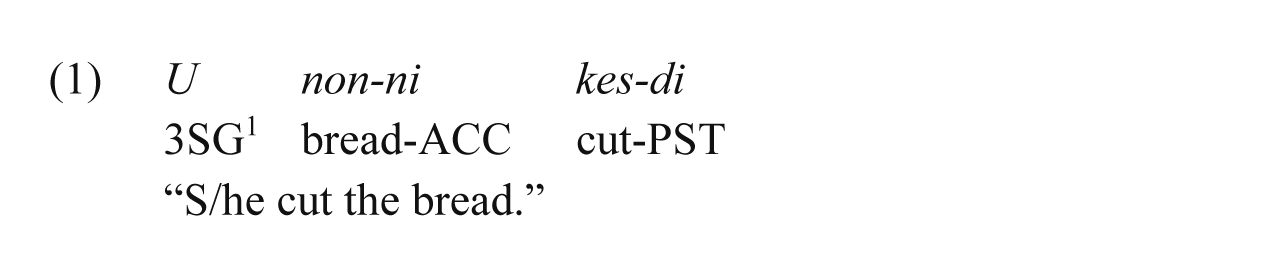
Here, as in English, the event involves edged penetration leading to division. However, Uzbek further subdivides the incision domain through the verb qirqmoq:
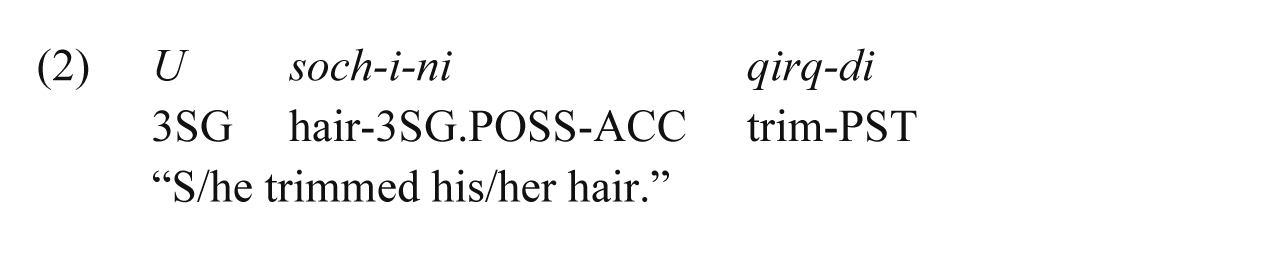
While both verbs involve cutting instruments, qirqmoq characteristically profiles segmented or surface-oriented removal, typically associated with scissors and reduction in length or volume. Although frequently associated with scissors, the contrast between kesmoq and qirqmoq is not reducible to instrument type but reflects a distinct construal of result configuration. Kesmoq licenses straightforward division into parts, whereas qirqmoq encodes controlled shortening or removal of a portion.
This boundary is visible in negative evidence. The manner-neutral division verb bo’lmoq and the splitting verb yormoq both accept an explicit binary-outcome frame, but qirqmoq resists it:
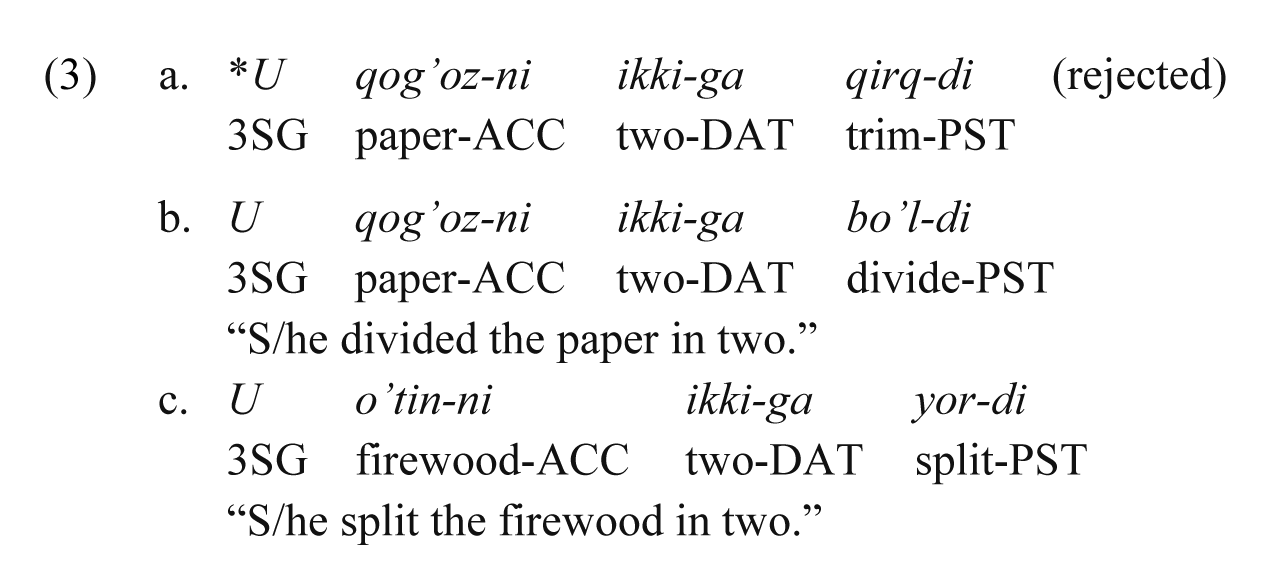
The contrast confirms that qirqmoq lexicalises reduction (the removal or shortening of a portion) rather than division into two substantial parts.
As noted in the discussion of verb selection, bo’lmoq “divide” falls within the domain but is manner-neutral: it entails separation into parts without specifying how. It is selected where no particular manner is foregrounded (qog’ozni ikkiga bo’ldi “divided the paper in two”), whereas a manner verb is chosen where a canonical manner is salient (a cake is cut, tortni kesdi; firewood is cleaved, o’tinni yordi).
English isolates a comparable reduction-oriented configuration through trim (e.g., trim one’s hair and trim a hedge). The two systems both subdivide the incision domain, but not identically: qirqmoq is characteristically associated with scissor- and shear-type cutting, whereas trim profiles neatening by removal of excess independently of instrument. Incision therefore does not, on its own, establish an asymmetry between the two systems; the clearer asymmetry emerges in the extension of fracture verbs across material classes, to which we turn below.
Structural splitting constitutes a distinct event type in both systems. English split and Uzbek yormoq encode separation that propagates along an inherent structural axis of the object. In Levin’s (1993) classification, split forms part of a verb class associated with internally structured separation events.

This holds tightly for Uzbek yormoq, which requires propagation along an inherent structural axis and resists contexts lacking one (*tortni yordi “split the cake” is odd). English split is broader: alongside axis-propagation (split the log), it extends to division into portions or shares where no axis is implicated (split the cake and split the group). In those non-axis contexts Uzbek selects other verbs: instrument-mediated division of a cake takes kesmoq (tortni kesdi “cut the cake into pieces”), while partition into shares takes the manner-neutral bo’lmoq. Split thus spans configurations that Uzbek distributes across distinct verbs. This is another instance of non-isomorphic boundary location, with the compression running in the opposite direction from the bread case discussed below.
Unlike incision verbs, which foreground penetration by an edged instrument, splitting verbs foreground the internal organisation of the patient. The event involves force-driven propagation along a grain, seam, or structural line, typically yielding two substantial and relatively intact parts. In Uzbek, yormoq strongly implies overcoming internal cohesion through substantial force, often associated with heavy tools such as an axe.
Splitting is therefore a point of convergence: both languages lexicalise it as a category distinct from incision and fracture, so no granularity asymmetry arises at the level of category inventory. (As noted above, the languages differ in the boundary of the splitting category, English split being broader than yormoq, but not in whether splitting is lexicalised.) That the divergences documented elsewhere do not surface here supports treating them as localised boundary effects rather than a system-wide difference between the two lexicons.
Fracture events are encoded by English break and Uzbek sindirmoq. In English, break belongs to a well-established class of change-of-state predicates centred on structural failure (Levin 1993). Such verbs lexicalise structural failure rather than controlled division and are prototypical result verbs under manner and result complementarity (Rappaport Hovav and Levin 2010). The two languages also mark the transitive and intransitive alternation differently. English break is labile: the same form serves as both causative and anticausative (he broke the glass and the glass broke) and supports a middle (this glass breaks easily) (Haspelmath 1993; Kaufmann 2007).

Uzbek, by contrast, marks the alternation morphologically: the intransitive and inchoative sinmoq “break” (as in oyna sindi “the glass broke,” where the theme undergoes a change of state with no overt causer) alternates with the causative sindirmoq (sin-dir-). What English leaves to lability, Uzbek encodes with -dir-. Participation in this alternation is a standard diagnostic of result (change-of-state) verbs (Beavers and Koontz-Garboden 2020; Levin 1993), and argument alternations serve more generally as verb-class diagnostics across typologically diverse languages (Okoye 2023). The marking contrast itself, lability versus overt morphology, is a well-documented axis of typological variation, one whose consequences extend into second-language acquisition (Elasri, Ed-Dali, and Bouhout 2025).
The core semantic component is loss of structural integrity. The resulting state may involve irregular fragmentation, cracking, or functional impairment. Unlike splitting verbs, fracture verbs do not presuppose propagation along a natural structural axis and do not entail preservation of substantial parts. They are compatible with both intentional and accidental causation. Here again, Uzbek and English encode parallel macro-event distinctions. The contrast between the languages does not concern fracture per se but rather, as the next section shows, how far the fracture category extends across material classes.
The contrast between Uzbek and English can be made explicit through a structured comparison of default (unmarked) lexical choices across controlled event configurations (Table 1). Default forms reflect neutral construal without contrastive emphasis. For bread, English uses cut as the unmarked verb when an instrument is involved; for manual division it has no unmarked simplex verb, resorting to break apart, break in half, or tear. Uzbek, by contrast, has the unmarked sindirmoq. This markedness asymmetry is discussed under Semi-rigid Materials: Bread.
The grid shows that both languages recognise the same macro-event schemas (incision, splitting, and fracture) but place their internal boundaries differently. The clearest asymmetry concerns manual division of bread, for which Uzbek has an unmarked simplex verb (sindirmoq) while English does not. These configurations are limited to neutral contexts without emphasis, metaphor, or contrastive focus, isolating default lexicalisation patterns rather than stylistic variation. The divergences thus concern boundary placement and extension range, not the availability of event types.
Importantly, the second verbs in the two languages are not co-extensive: although both systems distinguish further subtypes beyond the shared macro-event schemas, the semantic ranges covered by the additional verbs do not coincide.
Together, both languages lexicalise the same three macro-event types (incision, structural splitting, and fracture), so the two systems do not differ in granularity at the level of category inventory. The divergences documented above are boundary effects. Within incision, Uzbek qirqmoq and English trim each isolate a reduction-oriented subtype, but along different parameters (scissor- or shear-type manner for qirqmoq, telic neatening for trim), so their coverage cross-cuts rather than coincides. Within splitting, English split ranges over axis-propagation and non-axis division alike, configurations that Uzbek distributes between yormoq and bo’lmoq.
Granularity and compression remain useful as local, comparative descriptors of such cases: wherever one system’s single verb spans configurations that the other distributes across distinct verbs, the former is locally compressing and the latter locally granular. On this evidence, however, neither language is globally the more granular; the compression runs in different directions in different subdomains. What is systematic is boundary location: where each language draws the internal lines of shared categories, and how far it extends them across material classes. The question of extension is taken up in the next section.
4. Material Sensitivity and Asymmetrical Partitioning
Material compatibility provides a second diagnostic axis for lexical partitioning, revealing how event types interact with object-internal properties. In Talmy’s (2000) terms, event construal involves conceptual structuring of force dynamics and material resistance. Cross-linguistic research on separation events has shown that properties such as cohesion, internal structure, and resistance to force play a central role in verb selection (Majid et al. 2007). The distribution of incision, splitting, and fracture verbs across materials such as glass, wood, and bread therefore allows us to observe how languages calibrate the relationship between material properties and lexical encoding.
With brittle materials such as glass, the two systems converge in selecting fracture verbs:
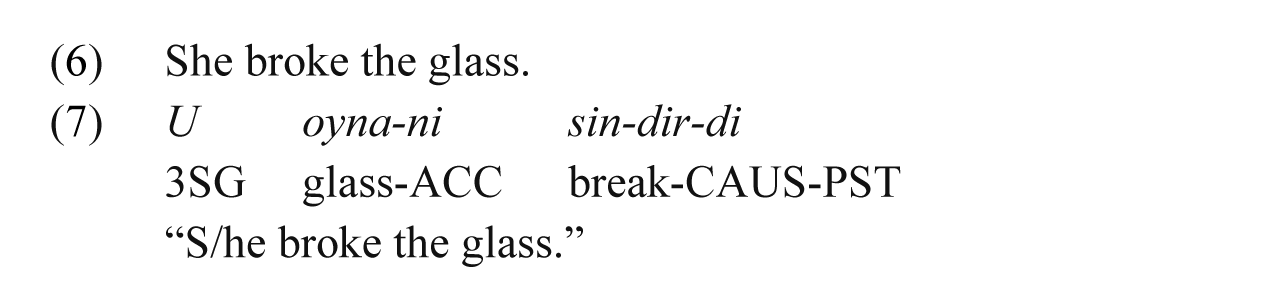
Incision verbs are disfavoured because the event is construed not as guided penetration but as structural collapse. In English, verbs of the break class are prototypical change-of-state predicates encoding loss of structural integrity (Levin 1993). The material’s low internal cohesion therefore favours fracture-based lexicalisation rather than incision or splitting.
In this domain, the mapping between material properties and event type is parallel across languages: brittleness correlates robustly with fracture encoding. No cross-linguistic asymmetry arises here.
Wood presents a structurally richer pattern. Both languages distinguish incision from structural splitting:
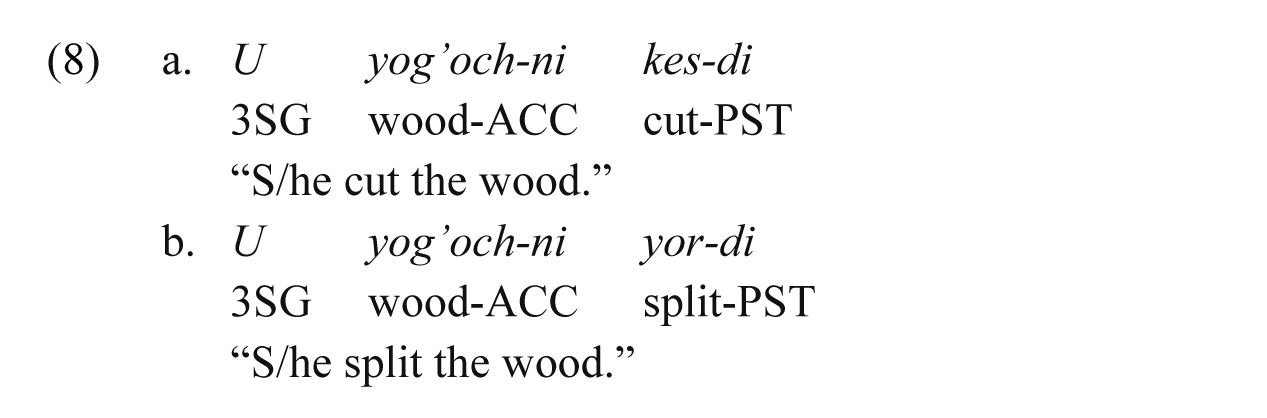
Here lexical choice depends on the construal of the internal organisation of the object. Kesmoq and cut profile penetration by a sharp implement, whereas yormoq and split profile force-driven propagation along an inherent structural axis (e.g., grain). The object’s directional internal structure becomes semantically decisive.
Again, Uzbek and English align: when structural directionality is salient, splitting verbs are selected; when instrument-mediated penetration is foregrounded, incision verbs are selected. Material structure therefore conditions verb choice similarly in both systems.
Bread reveals a typologically significant divergence. In English, division of bread is canonically lexicalised through incision:

Although break is possible, it is pragmatically marked in neutral contexts unless brittleness is emphasised (e.g., a crisp loaf). In English, both cut and break are available. Cut is strongly associated with knife-mediated slicing, while break is common for manual separation and in conventional expressions (e.g., break bread). The two verbs thus distribute according to instrument and construal rather than rigid material classification.
In Uzbek, by contrast, manual division of bread is typically expressed with sindirmoq:

The incision verb kesmoq is available when a knife is used, but sindirmoq is unmarked in ordinary contexts of manual separation. Native-speaker consultation indicates that this distribution reflects conventionalised lexical preference rather than stylistic variation.
The divergence does not concern the physical event but its linguistic categorisation. English conceptualises bread primarily as an object undergoing incision unless brittleness is foregrounded. Uzbek, by contrast, permits bread to be treated as structurally breakable in neutral contexts. The material therefore occupies different default positions within the event-type mapping of each language. From a semantic-map perspective (Rakhilina, Ryzhova, and Badryzlova 2022), bread occupies distinct adjacency relations between incision and fracture in the two systems, reflecting differences in internal connectivity within the separation domain.
Borderline cases further clarify this calibration. In Uzbek, “snapping a dry twig or a pencil” is naturally described with sindirmoq, reflecting a fracture-based construal, whereas dividing a carrot by hand may be expressed using ikkiga bo’lmoq (“divide into two”) rather than an incision verb. English, by contrast, readily generalises break across such snapping events. These distributions show that fracture extension in Uzbek is not confined to maximally brittle materials, but reflects a conventionalised categorisation of resistance and internal cohesion.
These cases illustrate how the diagnostic criteria operate in practice. In “snapping a dry twig,” the decisive parameter is loss of structural integrity without controlled bifurcation, which favours fracture (sindirmoq). In manual division of a carrot, however, speakers may select ikkiga bo’lmoq, indicating that neither instrument-mediated penetration nor canonical fracture fully captures the construal. Such borderline events demonstrate that macro-types are analytic categories derived from consistent diagnostic contrasts rather than stipulative labels.
The bread case provides a diagnostic illustration of extension range. While both languages recognise incision, splitting, and fracture as macro-event types, they differ in how flexibly these types extend across material classes.
English displays relatively tight alignment between material class and event type: semi-rigid food items default to incision. Uzbek exhibits greater flexibility in fracture extension, allowing sindirmoq to apply to semi-rigid materials without markedness.
Crucially, extension range is a dimension of boundary location, not a corollary of how finely a category is subdivided. Uzbek and English both subdivide the incision domain, though they locate the internal boundary differently (qirqmoq organised around scissor- or shear-type reduction, trim around telic neatening); and it is Uzbek, not English, whose fracture verb extends furthest across material classes. Internal subdivision and extension range therefore do not correlate mechanically: a system may draw a category’s internal boundaries in one place while extending its outer boundary more flexibly. Material sensitivity thus demonstrates that the divergence between the two systems cannot be reduced to verb count or lexical richness; it concerns how tightly event types are aligned with material categories and how selectively those alignments extend across borderline cases.
The asymmetry is structural rather than conceptual: both languages possess the same macro-event schemas, yet they calibrate the mapping between material properties and lexical encoding differently. This calibration further supports the claim that the divergence concerns the placement and reach of category boundaries within the domain, not the existence of distinct event types. If boundary placement is conventionalised rather than improvised in context, the assignment of borderline materials should be stable across speakers within each language, as the consultation data indicate for the Uzbek bread contexts, and further borderline material classes provide a natural testing ground for this expectation.
5. Result Configuration and Lexical Encoding of Outcomes
While distinctions in instrumentality and force dynamics structure the initial phase of separation events, lexical partitioning is equally sensitive to the configuration of the resulting state. Cutting, splitting, and breaking verbs do not merely encode how force is applied; they encode assumptions about the structural status of the object after the event. Result-state construal therefore constitutes a second major axis of lexical differentiation, consistent with event-structural analyses distinguishing manner-based and result-based verb classes (Rappaport Hovav and Levin 2010).
Splitting verbs in both languages, English split and Uzbek yormoq, entail division into two relatively intact and substantial parts:
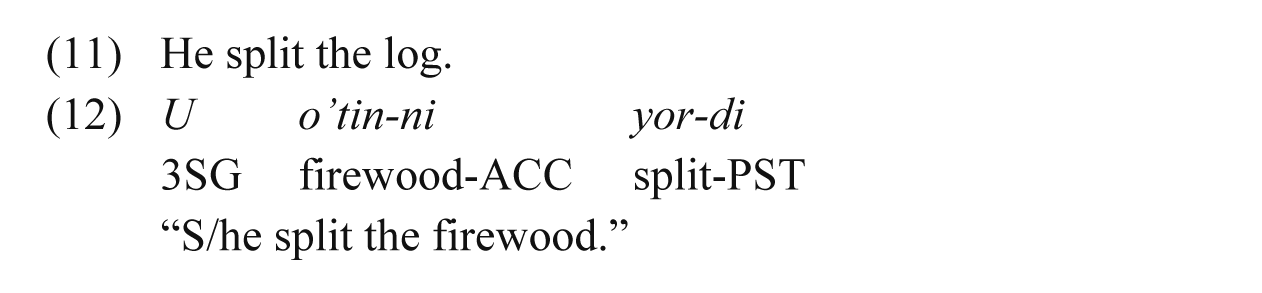
The resulting state preserves structural coherence within each part despite disruption of the original unity. The event culminates in controlled bifurcation along an inherent structural axis. Crucially, splitting verbs prototypically entail binary outcome structure and retention of part-level integrity. Destruction is not entailed; rather, the object is reconfigured into two substantial components. Uzbek and English exhibit parallel lexicalisation in this respect.
Fracture verbs, English break and Uzbek sindirmoq, encode a distinct result configuration. In English, break belongs to a well-established class of change-of-state predicates centred on structural failure (Levin 1993):
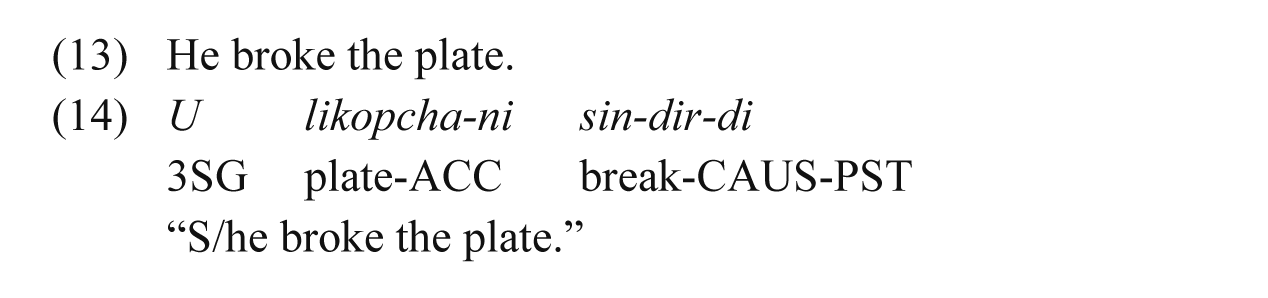
The semantic focus lies on loss of structural integrity. The result may involve cracking, shattering, irregular fragmentation, or functional impairment.
Unlike splitting verbs, fracture verbs entail loss of structural integrity (denying it is contradictory: #He broke it but nothing is different about it) but neither entail nor exclude binary division; a binary outcome is available under explicit marking (break in half; Uzbek ikkiga sindirdi).
The lexical meaning foregrounds structural failure rather than division as such. At the macro level, Uzbek and English again align closely in their encoding of this event type.
Incision verbs occupy a third configurational zone. English cut and Uzbek kesmoq primarily profile penetration by an edged instrument:
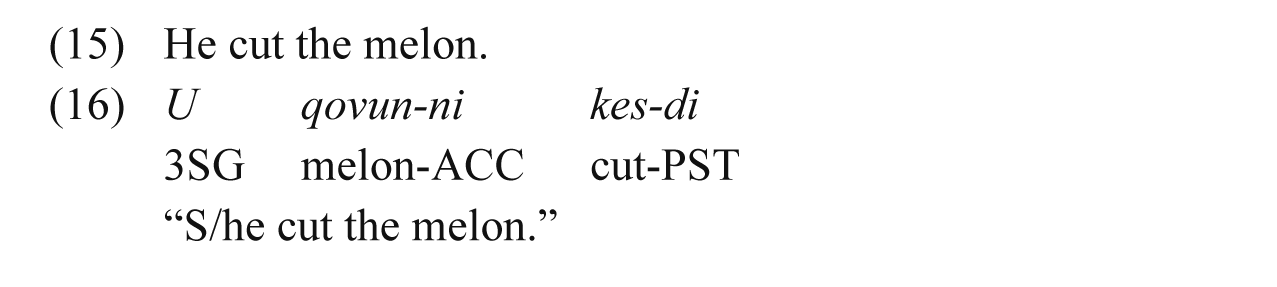
Cut and kesmoq entail separation by an edged instrument but do not lexically specify the resulting geometry. In unmarked use, the default is division into discrete parts; readings in which only a small portion is removed require explicit marking (cut a slice off; Uzbek kesib oldi). The verb thus underspecifies result geometry while still entailing division; it foregrounds manner over a fully specified result configuration.
Uzbek qirqmoq, however, introduces configurational narrowing:
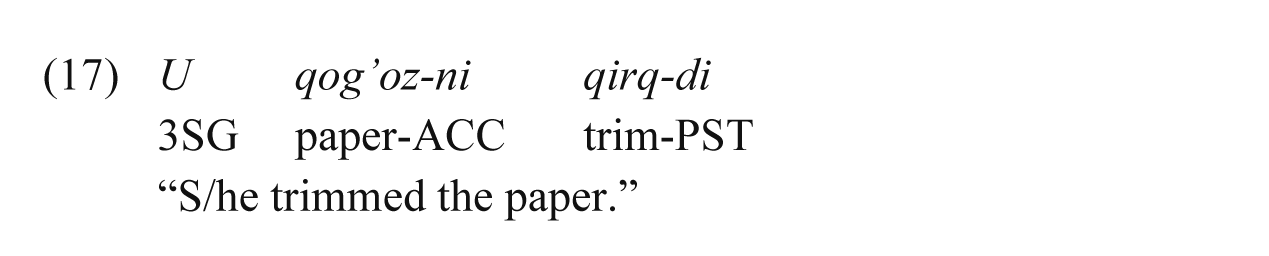
As the negative evidence above shows (3a, b), qirqmoq is incompatible with an ikkiga “into two” frame, confirming that the reduction construal is entailed rather than merely preferred. Here the resulting state is specifically construed as reduction or shortening. The event involves controlled removal of part of the object rather than mere penetration. In other words, qirqmoq lexicalises a more narrowly specified result configuration within the incision domain.
English isolates this reduction-oriented outcome through trim, so the configuration is lexically available in both languages rather than compressed under cut in English alone. What differs is the basis of the distinction: qirqmoq foregrounds scissor- or shear-type manner, trim foregrounds the telic result of neatening. The trimming-oriented configuration encoded by qirqmoq does not merely represent a scalar reduction in quantity but a structurally distinct event template, a distinction that parallels observations in NSM analyses of non-scalar semantic contrasts (Goddard 2013).
Comparison across splitting, fracture, and incision demonstrates that lexical partitioning operates along two interacting dimensions: (i) force and manner profile and (ii) result-state configuration. At the macro level of incision, splitting, and fracture, Uzbek and English share parallel event schemas. The divergences emerge in how the resulting categories are bounded: within incision, the reduction subtype is isolated along different parameters in the two systems, and the general verbs differ in what they leave to context.
Within the restricted domain examined here, Uzbek shows near one-to-one alignment between event subtype and verb choice: (i) kesmoq for general incision, (ii) qirqmoq for trimming-oriented reduction, (iii) yormoq for structural bifurcation, and (iv) sindirmoq for structural failure. English commands the same distinctions (cut, trim, split, and break) but bounds them differently: trim isolates reduction by telic result rather than by manner, and split extends beyond axis-guided bifurcation.
Result-state evidence thus reinforces the boundary-location analysis. Both systems lexicalise the reduction configuration, but they define it along different parameters; both lexicalise bifurcation and fracture, but bound them differently against neighbouring configurations. The comparative alignment of event type, force profile, and result configuration is summarised in Table 2.
6. Discussion and Concluding Remarks
The comparison shows that Uzbek and English partition the cutting–breaking domain along comparable macro-semantic dimensions (incision, structural splitting, and fracture) but differ systematically in where they place the internal boundaries of these categories and how far they extend them across material classes. The divergence is structural rather than conceptual, consistent with approaches in lexical typology that distinguish conceptual organisation from language-specific lexical partitioning (Koptjevskaja-Tamm, Rakhilina, and Vanhove 2016; Majid 2015).
These divergences are matters of boundary location, not category inventory. Within incision, Uzbek qirqmoq and English trim each isolate a reduction-oriented subtype, but along different parameters (instrument-and-manner for qirqmoq, telic neatening for trim), so the two are not equivalents and their coverage cross-cuts. Within splitting, English split ranges more widely than axis-committed Uzbek yormoq. The most robust asymmetry concerns extension across material classes: Uzbek extends the fracture verb sindirmoq into semi-rigid materials such as bread, where English defaults to incision and has no unmarked verb for manual division. The variation therefore lies not in the semantic distinctions available, which both lexicons share, but in where each places its lexical boundaries.
Within Evans’s (2011) three axes of lexical categorisation, this variation falls under boundary location rather than granularity: at the level of category inventory the two systems are equally granular, and the notions of granularity and compression (Hobbs 1985; Mani 1998) apply only locally, as comparative descriptors of individual verbs that span configurations a comparison language distributes across distinct items. In domain-based lexical typology, variation is often described in terms of how semantic space is partitioned across lexical items (Koptjevskaja-Tamm 2008; Rakhilina and Reznikova 2014); the present study sharpens that description by separating the inventory of categories from the placement of their boundaries.
The granularity axis, even in this local use, must be distinguished from related notions. It is not the same as lexical flexibility (van Lier 2016), which concerns the syntactic distribution of a lexeme across constructions, nor is it reducible to semantic-map connectivity (Rakhilina, Ryzhova, and Badryzlova 2022), which models cross-linguistic extension pathways but does not measure how densely distinctions are lexicalised within a single system. Granularity instead targets the branching depth of a semantic field: how finely event subtypes are mapped onto distinct lexical forms.
Unlike manner and result complementarity, which concerns which semantic component a verb lexicalises, granularity concerns how many lexemes are needed to encode distinguishable configurations within a domain; and unlike Talmy’s lexicalisation patterns, which describe how conceptual components are packaged into verbs, it describes how densely those packages are distributed across a lexical field. It therefore adds a structural dimension not captured by event decomposition or lexicalisation-pattern typologies: how densely event templates are distributed, rather than how each template is internally composed.
Crucially, these divergences do not imply greater conceptual complexity on either side. Both lexicons are equally granular at the level of category inventory; they differ only in where the internal boundaries fall and how far each extends across material classes, most clearly in the extension of the fracture category, with Uzbek sindirmoq reaching into semi-rigid materials where English defaults to incision. This pattern of shared categories with divergent boundary placement and extension range resonates with recent work on semantic paths of lexicalisation (Mihatsch 2025), which emphasises that lexical systems may evolve through domain-internal boundary shifts and cross-domain extension. Boundary location, in this sense, captures the synchronic structural outcome of such lexicalisation pathways.
These distinctions generate testable expectations. Where a language’s verb is broader than its counterpart’s (split relative to yormoq, or cut relative to kesmoq and qirqmoq in reduction contexts), recovery of configurational detail should rely on contextual enrichment or explicit marking, whereas the narrower verb constrains interpretation lexically. Boundary placement itself is predicted to be conventionalised: the assignment of borderline materials such as bread should be stable across speakers within each language and resistant to contextual override in neutral settings. And because qirqmoq and trim bound the reduction configuration along different parameters, translation between the two systems should be asymmetric in identifiable ways.
A further point follows from the entailment differences established above. The general verbs cut and kesmoq entail division but leave result geometry underspecified; in unmarked use they default to division into parts, and a reduction reading (removing or shortening a portion) requires either marking or the dedicated reduction verb (English trim, Uzbek qirqmoq), which entails it. Both languages therefore constrain interpretation through verb selection in the same way: choosing between a general incision verb and a dedicated reduction verb fixes whether reduction is entailed. This is a property of the lexical contrast itself, not an asymmetry between the two systems.
The manner and result complementarity invoked here (Rappaport Hovav and Levin 2010) is not uncontested: using truth-conditional diagnostics, Beavers and Koontz-Garboden (2012, 2020) identify roots that encode both manner and result, arguing for a richer typology of roots while still retaining complementarity as a constraint on how roots combine in event structure. The present analysis does not require a strict manner-or-result partition; it needs only that incision verbs foreground instrument-manner and fracture verbs foreground a result of structural failure, claims that the entailment diagnostics above support. In the cutting–breaking domain, the two languages share these manner and result contrasts and diverge only in where the resulting categories are bounded, not in how densely the contrasts are drawn.
The Uzbek–English comparison thus illustrates how variation in boundary placement shapes the internal organisation of a semantic domain without altering its underlying event structure. The languages do not differ in the kinds of separation events they can conceptualise, but in how those events are lexically distributed: in Talmy’s (2000) terms, the conceptual structuring systems remain comparable, while the lexical packaging of those primitives differs.
Methodologically, the study underscores the value of tightly delimited domain-based comparison. By isolating a controlled semantic field and conducting language-internal analysis prior to contrastive alignment, it brings to light boundary differences that gloss-based comparison obscures: apparent equivalents such as cut and kesmoq, or break and sindirmoq, conceal systematic differences in event construal and material categorisation. This bears directly on translation and applied linguistics, where such surface equivalences may mask non-equivalence (cf. Kim 2026 on category-sensitive translation strategies); a domain-based contrastive perspective offers a principled framework for identifying and analysing these asymmetries.
The study is limited to two languages and a restricted verb set. Broader typological testing will be required to determine whether boundary location behaves as a systematic locus of variation among languages that share a category inventory. Nevertheless, the analysis shows that boundary placement and extension range can vary independently of shared conceptual structure. The findings suggest that lexical typology must account not only for differences in category inventory across languages, but also for variation in where shared categories are bounded within individual systems.


